How to Set Up a Simple Morning Routine

You might think a simple morning routine is impossible, because it sounds like it means waking at 5 a.m., running three miles and drinking something green. It can easily last only two days, and the third morning may be spent hitting snooze and feeling like you've failed at something before breakfast.
What actually worked for me was much smaller. A few simple habits, done in the same order, most days. That's it. If you've tried big routines before and they fell apart, this way might suit you better. Start small and add one step at a time.
Below, I'll walk you through how I set mine up, what I'd do differently and what to try when things don't go to plan.
Short on time? Our top picks: Hatch Restore, Amazon Basics Digital Alarm Clock, Stanley Quencher Tumbler and Hydro Flask Water Bottle. See all picks

What You Need for a Simple Morning Routine
You don't need to buy anything to start. Here's a simple routine to try:
- An alarm (your phone is fine, but a cheap separate alarm clock helps with Step 5)
- A glass or water bottle you like, such as a Hydro Flask or a Stanley tumbler
- A small patch of floor with enough room to stretch (a yoga mat, like one from Manduka, is nice but optional)
- A notebook, such as a Leuchtturm1917, and a pen for your morning gratitude journal
- About 15 to 20 minutes, to begin with
That's the whole list. If you find yourself shopping for the perfect journal before you've done a single morning, gently stop. It's a common experience. The fancy notebook sat in a drawer for months.
Step 1: Pick a Wake Time You Can Actually Keep
This is the base for everything else. If your wake time keeps changing, the rest of the routine has nowhere to stand.
Pick a time that's realistic for your real life, not your dream life. Look at when you have to leave the house or start work. Then add the 15 or 20 minutes your routine needs, plus a little buffer for the morning you can't find your keys.
Here's how I'd do it:
- Write down the time you usually wake up now.
- Set your new wake time no more than 15 minutes earlier than that.
- Keep it the same on weekdays. Weekends can be a bit looser if you want.
- If it feels fine after a week or two, you can move it earlier again, in small steps.
Tip: Put your alarm across the room. It's an old trick, but it works. By the time you've walked over to turn it off, you're already standing up, and that's half the battle.
One honest note: a morning routine leans heavily on how you slept. If you're often tired no matter what you do, that's worth mentioning to a doctor. A routine can't fix a sleep problem.
Step 2: Drink a Glass of Water
This one sounds almost too simple to count. That's why I like it.
Before coffee, before checking anything, drink a glass of water. Fill yours the night before and leave it on the kitchen counter, so it's waiting for you. No decisions needed, just pick it up.
It won't necessarily change your life. What it does offer is a clear first move for your morning. That matters more than you'd think. When the first step is easy, the next one feels easier too.
Tip: If plain water feels boring, add a slice of lemon or drink it warm. Warm water with a bit of lemon is an option in winter, and it can feel like a small treat rather than a chore.
Step 3: Stretch for Two Minutes
Two minutes. Not a full yoga class, not a workout. Just enough to let your body know the day has started.
Keep it gentle. Here's a simple set I do most mornings:
- Reach both arms up over your head and hold for a few slow breaths
- Roll your shoulders back a few times, then forward
- Gently tip your head side to side
- Bend forward softly with your knees relaxed and let your arms hang
- Stand up slowly and take one big breath
Move slowly and stop if anything hurts. If you have an injury or a health condition, check with a doctor or physio about what's safe for you. Stretching should feel nice, not like a test.
Tip: Do it next to where you drank your water. Linking habits to the same spot made a real difference for me. Water, then stretch, right there in the kitchen. Over time your body can start doing it before your brain has fully woken up.
Step 4: Write Three Lines in Your Morning Gratitude Journal
This is the step I almost skipped, and now it's my favourite.
Open your notebook and write three lines. That's all. You can write things you're grateful for, or plans for the day, or a mix. Some mornings mine look like this:
- Grateful the rain stopped before my walk yesterday.
- Call Mum at lunch.
- Don't overthink the email. Just send it.
It's not deep. It doesn't need to be. The point is to spend a minute with your own thoughts before the rest of the world gets a say.
If you want a little structure for this, I put together some Free 7-Day Gratitude Journal Pages you can get by joining the email list, and they're a nice way to try a calm morning routine for a week without staring at a blank page.
Tip: Keep your notebook and pen out where you'll see them, not tucked in a bag. If I have to go find it, I won't. Honestly, that's the truth about most habits.
Some people like having a morning routine printable or a short phrase to read before they write. If that sounds like you, the Morning Affirmation Cards and Routine Pack below this post was made for exactly that kind of morning. You don't need it, though. A plain notebook works fine.
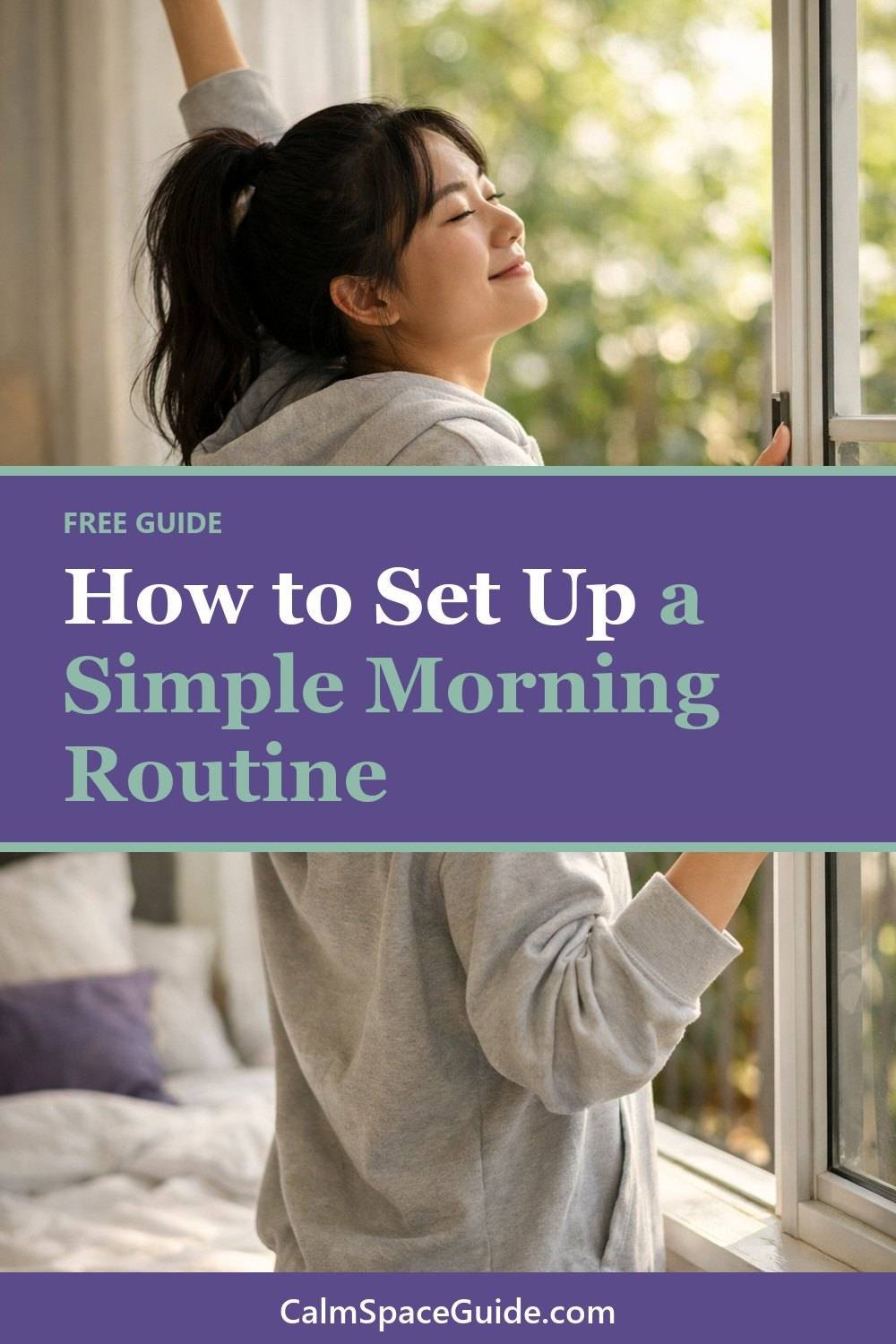
Step 5: Skip Your Phone for Ten Minutes
To be upfront, this is often the hardest step. For years, the first thing I did was reach for my phone and scroll through messages and news while still lying in bed. By the time I got up, my head was full of other people's problems.
The goal here is just ten minutes. You're not giving up your phone. You're just not letting it be the first voice you hear.
Here's what helped me:
- Charge your phone outside the bedroom, or at least out of arm's reach.
- Use a separate alarm clock if you can. Then your phone has no excuse to be near you.
- Do Steps 2 to 4 first. By the time you're done, ten minutes have passed without much effort.
- If you need your phone for an alarm, turn off notifications overnight so you don't see a pile of them when you wake up.
Tip: Don't try to go an hour without it on day one. Ten minutes is enough to notice a difference. Some mornings I go longer now, but I didn't start there.
Step 6: Review Your Morning Routine After a Week
After seven days, sit down for five minutes and look back. Be honest, but be kind to yourself too.
Ask yourself a few questions:
- Which steps did I actually do?
- Which one did I keep skipping, and why?
- Did my wake time work, or was it too ambitious?
- Is there a step I'd like to add, or one I'd drop?
Then adjust. Maybe the stretching works better after a shower. Maybe you'd rather write your three lines with your coffee. That's all fine. The routine is meant to fit you, not the other way round.
Tip: Only change one thing at a time. When I changed everything at once, I couldn't tell what was helping and what wasn't.
Troubleshooting: When Things Don't Go to Plan
Some mornings will go sideways. Mine still do. Here are the problems I've hit most often and what I did about them.
I keep hitting snooze
Your wake time might be too early for now. Move it back by 10 or 15 minutes and see if that helps. Also, check your bedtime. Waking up earlier is hard unless you also start going to bed a bit earlier.
I forget the steps
Write them on a sticky note and put it on the kettle, the fridge or the bathroom mirror. After a couple of weeks, you won't need it. Until then, there's no shame in a reminder.
I don't have time on busy days
Have a short version ready. On rushed mornings, I just drink my water and write one line. It keeps the habit alive, even if it's tiny. Doing a little beats skipping it completely.
I missed a few days and feel like I've ruined it
You haven't. Just start again tomorrow. Even after whole weeks off during travel or illness, a routine often comes back faster than you'd expect. Missing a day isn't failing. Quitting because you missed a day is the only real trap.
It feels boring
Honestly, a bit of boring is the point. Calm mornings aren't meant to be exciting. That said, you can swap things around. Try a new stretch, write somewhere different, or drink your water outside if the weather's nice.
What I'd Skip
A few things get talked up a lot that I don't think you need, at least not at the start.
Waking up super early is overrated for most people. If 7 a.m. works for your life, 7 a.m. is a great wake time. Long checklists are another one. A ten-step routine can leave you feeling behind every single morning. And tracking apps can be fun, but for me they turned a calm habit into another thing to check on my phone, which kind of defeated Step 5.
Keep it simple first. You can always add more later, like a morning routine printable download or a small yoga mat set for stretching.
Tools That Can Make a Simple Morning Routine Easier
You really don't need any of these to begin. If you'd like a little help with the alarm, the water, the stretching or the writing, these are real options worth a look.
Hatch Restore
This is a sunrise-style alarm clock that sits on a bedside table, so your phone can stay in another room. It suits people who want a gentler wake-up and a phone-free start. Check that its size, setup and any app or subscription needs match what you want.
Amazon Basics Digital Alarm Clock
A plain, simple alarm clock is enough for the phone-free step. It suits anyone who wants the cheapest, least fussy option. Check the display brightness and how loud the alarm is before you buy.
Stanley Quencher Tumbler
A big insulated tumbler makes it easy to fill your water the night before and leave it ready. It suits people who like a bottle they enjoy carrying around. Check the size, weight and whether the lid fits your habits.
Hydro Flask Water Bottle
A sturdy reusable bottle works well for a morning glass of water and for the rest of the day. It suits people who want something durable. Check the capacity, lid style and whether it fits your cup holder or bag.
Manduka Yoga Mat
A mat gives you a set spot for your two minutes of stretching. It suits people who want a cushioned, non-slip surface on a hard floor. Check the thickness, grip and weight, especially if you'll roll it up each day.
Leuchtturm1917 Notebook
A well-made notebook is a nice home for your three lines each morning. It suits people who like a tidy, numbered page layout. Check the page size and paper type, and choose a pen that won't bleed through.
Day One Journal App
This is a journaling app for people who would rather type than handwrite. It suits anyone who wants entries kept in one place on their phone or computer. Check which features are free, how it handles backups and whether you're happy writing on a screen in the morning.
Please check current plans and prices on each brand's own site before you decide.
FAQ
How long should a simple morning routine take?
Start with about 15 to 20 minutes. That's enough time to do all the steps here without rushing. If it feels good after a few weeks, you can make it longer, but there's no need to.
What if I'm not a morning person?
Plenty of people aren't, me included for a long time, and a calm morning routine can still work for you. Keep the steps very small and pick a wake time that feels kind, not harsh. A gentle routine often feels better than none, even for night owls.
Should I do the steps in the same order every day?
The answer is yes, at least at first. Doing them in the same order helps them become automatic, so you don't have to think about it when you're half asleep. Once it's a habit, you can shuffle things if you like.
Can I have coffee as part of my routine?
Of course. You could drink your water first, then make coffee while you stretch. Many people find their coffee is the best part of the morning, so build it in wherever it feels right.
Your Next Step
If you want to start tomorrow, pick your wake time tonight and fill a glass of water for the counter. That's enough for day one. To make the writing step easier, grab the Free 7-Day Gratitude Journal Pages by joining the email list. Then, if you'd like a few extra tools, take a look at the products below this post, including the Morning Affirmation Cards and Routine Pack. Go slow, be patient with yourself, and let me know how your first week goes.
Printables and tools that can help
Morning Affirmation Cards and Routine Pack
Printable affirmation cards and a simple morning routine...
See detailsCalm Practice Daily Deals Feed Publishing Kit
Printable bullet journal layouts: habit, weekly and monthly...
See details