How to Start a Gratitude Journal in 5 Minutes a Day
Published 2026-10-16

Many people assume gratitude journals are for those with tidy desks and matching pens, but any notebook will do. Then a friend handed me a cheap notebook during a rough winter and said, "Just write one good thing before bed. That's it." I rolled my eyes. It's also easy to keep doing, because it's so simple that there are few excuses left.
That's the whole secret, really. Starting a gratitude journal takes a pen and about five minutes, and a daily gratitude journal habit can grow from there. You don't need a special system or a perfect morning routine. Here's how I'd set one up if I were starting today, plus what to do when it stops feeling fun.
Short on time? Our top picks: Moleskine Classic Notebook, Leuchtturm1917 Notebook, Rhodia Notepad and Pilot G2 Pen. See all picks

What you need
- A notebook, or a few printed pages in a folder or binder
- A pen you actually like writing with, such as a Pilot G2
- Five minutes, once a day
- A spot where the journal can sit in plain sight
- Optional: a short list of prompts for days when your mind goes blank
That's genuinely it. You can skip the fancy planner with fifty sections and stickers. A fancy journal looks lovely in the shop, but the more complicated the book, the faster it tends to end up in a drawer.
Step 1: Choose your gratitude journal notebook or format
Pick something you'll enjoy opening. A plain lined notebook from the supermarket works fine as a gratitude journal notebook, and so does a classic option like Moleskine if you want something a bit nicer. So does a gratitude journal printable clipped into a binder, which is nice if you like a bit of structure without buying a whole book.
Some people use a notes app or a journaling app like Day One on their phone. Try it for a month and see how it feels. It worked, but I kept getting pulled into messages and news the second I unlocked the screen. Paper keeps the five minutes calm. If phones don't distract you the way they distract me, go ahead and use one.
Think about size, too. A small notebook feels less scary. A big blank page can make you feel like you have to fill it, and that pressure is exactly what you're trying to avoid.
Tip: Don't wait to find the "perfect" notebook. Use whatever's in your house today. You can always switch later once you know what you like.
Step 2: Pick a time and tie it to a habit
Lots of people write in the evening, just before bed. It's a gentle way to look back at the day. Others prefer the morning with a cup of tea, when the house is still quiet.
Neither is better. What matters is linking your journal to something you already do every day without thinking. Some ideas:
- Right after you brush your teeth at night
- While the kettle boils in the morning
- When you sit down after dinner
- On your lunch break, before you check your phone
You can keep yours on your pillow during the day. When I go to bed, I have to move it, so I write in it. It may seem silly, but it can work better than a reminder app.
Tip: Leave the pen tucked inside the notebook. If you have to hunt for a pen, you'll skip it more often than you'd think.
Step 3: Start small with three short lines
Write down three good things from today. Keep each one short. One line is plenty.
They can be tiny. In fact, tiny is better. Here's a real page from one of my old notebooks:
- The bus driver waited when he saw me running.
- Hot soup on a cold, wet day.
- My neighbour's cat sat on my doorstep and let me pet him.
Nothing dramatic happened that day. That's kind of the point. Most days are made of small moments, and this habit trains you to notice them instead of letting them slide past.
Some days you'll want to write more. Go for it. But keep three lines as your floor, not your ceiling. On a tired night, three lines is something you can always manage.
Tip: Set a timer for five minutes if you tend to overthink. When it rings, you're done, even if you only wrote one line.
Step 4: Be specific
This step made the biggest difference for me. When starting out, it's common to write things like "family," "health," and "my home" over and over. They were true. They also got boring fast, and after two weeks I felt nothing writing them.
Compare "family" with "My sister called just to tell me a funny story about her dog." The second one puts you right back in the moment. You can almost hear her laughing.
A few ways to get more specific:
- Name the person
- Mention when or where it happened
- Add one small sensory detail, like a smell, a sound or the weather
- Say why it mattered, even in a few words
You don't need to do all of these every time. Just one detail makes a line feel alive.
Tip: If you catch yourself writing the same entry you wrote yesterday, ask "What exactly about it?" Then write that instead.
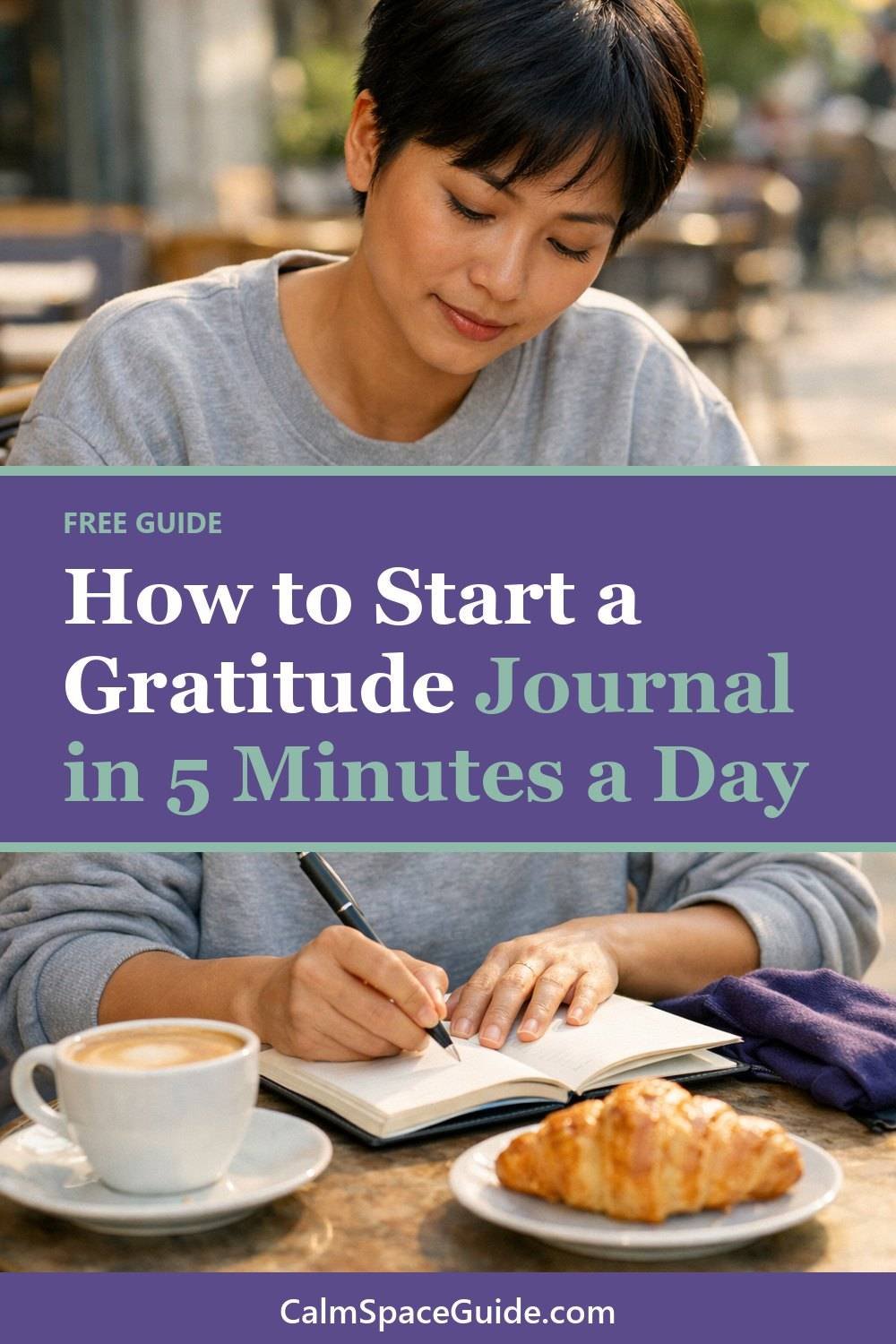
Step 5: Try a guided gratitude journal approach when you get stuck
Some evenings you'll sit down and your head will be completely empty. Maybe the day was rough. Maybe it was just dull. That's normal, and it's where prompts help.
Here are some guided prompts I come back to:
- Who helped me this week, even in a small way?
- What am I looking forward to?
- What's something you used today that you'd miss if it broke?
- What made me smile, even for a second?
- What's one thing my body let me do today?
- What's a small problem that turned out fine?
- Which place made me feel calm recently?
Write a few of these on the inside cover of your notebook. When you're stuck, flip it open and pick one. No thinking required.
If you'd like a head start, the Free 7-Day Gratitude Journal Pages are yours when you join our email list, and they come with prompts already on each page.
Tip: On a hard day, it's fine to write "I got through today." That counts. Gratitude doesn't mean pretending everything is great.
Step 6: Review once a week
Once a week, read back over your entries. You might do yours on Sunday morning, ideally with coffee and nowhere to be.
It sounds like a small thing, but this is the part I'd miss most if I stopped. During the week, the moments feel scattered. Reading seven days of them in a row is different. You see a whole stack of small good things you'd already forgotten.
You might also notice patterns. For me, a lot of my good moments involved being outside, even briefly. That nudged me to take a short walk at lunch more often. Your patterns will be your own.
You can jot a short note at the end of the week, like "Best moment this week" or "Something I want more of." Keep it to a line or two.
Tip: Don't judge old entries. If a day looks thin, that's fine. The review is for noticing, not grading yourself.
Troubleshooting: when it isn't working
"I keep forgetting."
Move the journal. Seriously. If it's in a drawer, you'll forget it. Put it somewhere you can't avoid, like next to your toothbrush, on your pillow or on top of the kettle. Linking it to an existing habit, as in Step 2, usually fixes this within a week or two.
"It feels fake or forced."
This one's common. Usually it means the entries are too big and too general. Go smaller and more specific. "Clean sheets" feels more honest than "I'm grateful for my life" on a grumpy Tuesday. You're allowed to be in a bad mood and still notice one okay thing.
"I missed a week and now I feel guilty."
Just start again tonight. Don't go back and fill in missed days, and don't write an apology to your notebook. Gaps of a month or more happen, and they are normal. The journal didn't mind. Pick it up and write three lines like nothing happened.
"It's getting repetitive."
Try a new rule for a week. For example, only write about people, or only things you saw, or only things that happened before noon. A small change like that makes you look at your day differently.
"I'm too tired at night."
Switch to mornings and write about yesterday. Or cut it down to one line. One honest line beats three lines you resent writing.
Keep it light
There's no right or wrong way to keep a gratitude journal for adults or anyone else. Messy handwriting is fine. Spelling mistakes are fine. Crossing things out is fine. Nobody is going to read it unless you want them to.
The aim is just to notice the good moments a bit more often. Not to be perfect, and not to turn it into another thing on your to-do list that you feel bad about.
One honest note: a journal is a personal writing habit. It can be a nice part of your day, but it doesn't replace professional support. If you're struggling with your mood or feel low for a long stretch, please talk to a doctor or a qualified professional.
If you like printed pages, the draft version of this post mentioned a gratitude journal printable pack on our Shop page with daily, weekly and monthly review pages. If you look at it, check the seller's page for the current price and exactly what's included before you buy anything.
Notebooks and apps worth a look
You really can start with any notebook in the house. If you'd like something nice to write in, or an app to nudge you, here are a few well-known options.
Moleskine Classic Notebook
Suits people who like a sturdy, familiar notebook that feels a bit special to open. Check the page size and whether you want ruled or plain pages, since a smaller book feels less daunting.
Leuchtturm1917 Notebook
Suits anyone who likes numbered pages and an easy way to find old entries for the weekly review. Check the size and paper style in person or in the product description before choosing.
Rhodia Notepad
Suits people who enjoy smooth paper and a simple, no-fuss pad. Check whether the format is stapled or bound, because that changes how it sits on a bedside table.
Pilot G2 Pen
Suits anyone who wants an easy, comfortable pen to leave tucked in the notebook. Check the tip size, as some people prefer a finer or bolder line.
Day One Journal App
Suits people who would rather type than write by hand and want entries kept in one place. Check which features are free and which need a subscription, and be honest about whether your phone distracts you.
Presently Gratitude App
Suits readers who like a simple, app-based gratitude routine with a gentle structure. Check what is included in the free version and how reminders are set up.
Five Minute Journal
Suits people who want a ready-made layout with set questions each day rather than a blank page. Check whether the physical book or the app format suits you better, and whether the structure feels helpful or too rigid.
Check current plans and prices on each brand's own site before you buy or sign up.
FAQ
How many things should I write each day?
Three short lines is a good starting point. It's enough to make you look for good moments but small enough to do when you're tired. If one line is all you can manage, that still counts.
Is morning or evening best for a gratitude journal?
Neither is better. Pick the time you're most likely to stick with, and tie it to something you already do daily. If one time isn't working after a couple of weeks, try the other.
Can I repeat the same things?
Yes, now and then. If you love your morning coffee, write it down. But if every entry looks the same, try adding a specific detail so the moment feels fresh again.
Do I need a special journal for starting a gratitude journal?
No. Any notebook or a few sheets of paper will do. Start with what you have, and only buy something new if you find you really enjoy the habit.
Your next step
Grab any notebook and write three small good things tonight, whether you're a teen, a busy mum, or anyone in between. If you'd like some ready-made pages to get you going, sign up for the Free 7-Day Gratitude Journal Pages using the box on this page. Try them for a week, see how it feels, and then decide if you want to keep going. Five minutes is all it takes to find out.
Some links on this site may earn us a commission. Read our disclosure.