How to Start a Gratitude Journal in 5 Minutes a Day

Many people put off starting a gratitude journal, and starting sooner is worth it. It's easy to picture some leather notebook, a quiet morning, and a cup of tea going cold during long, thoughtful pages. That never happened. What finally worked was a daily gratitude journal habit that was much smaller: one pen, one page, five minutes, done.
If you've tried before and quit, or you've never started because it felt like one more thing on your list, this beginner-friendly guide to how to start a gratitude journal is for you. It's a low-pressure way to begin. You don't need to be a writer. You don't need to feel especially grateful on the day you start, either. Some days I sit down feeling grumpy and write anyway, and it still counts.
Here's exactly how I do it, step by step, plus what to do when it stops working.
Short on time? Our top picks: Leuchtturm1917 Notebook, Moleskine Classic Notebook, Five Minute Journal and Pilot G2 Pens. See all picks

What you need for starting a gratitude journal
- A pen that you like using. Sounds silly, but a scratchy pen is a reason to skip.
- A gratitude journal notebook or any page. A cheap notebook, a Moleskine if you want something nicer, loose paper, the back of an envelope. Any of it works.
- A timer. Your phone, a kitchen timer, or the microwave clock if you're near it.
- Five minutes. That's the real requirement. Everything else is optional.
That's genuinely all. You can skip buying fancy stickers, washi tape or special colored pens at the start. They're fun, but they can turn a quick habit into a craft project, and craft projects are easy to put off.
Step 1: Gather a pen and a page
Before you do anything else, pick one notebook or pad and decide it's your gratitude spot. Keep the pen with it. Clip it to the cover, tuck it in the spiral, or keep them together in a small pouch.
The reason this matters is simple. If you have to go hunting for a pen, you'll lose the moment. Keep your notebook and pen together on the nightstand, not in separate rooms, so nothing slows you down. It's easy to miss more days than you write.
Don't worry about the first page being perfect. Some people freeze on a clean notebook. If that's you, scribble on the first page on purpose, or just start on page two.
Tip: If you want a notebook that's set up for this kind of daily writing, the Calm Space Journal and Log Book is below this post. A plain notebook from the drugstore works just as well, though. Use what you have first.
Step 2: Set a five-minute timer
Start the timer, then start writing. When it rings, stop. Even if you're mid-thought.
This might feel strange. Why stop if it's going well? Because the goal right now isn't to write a lot. It's to come back tomorrow. When you keep it short, you finish feeling like it was easy. That feeling is what gets you to sit down again.
On the flip side, five minutes can feel long on a day when you've got nothing. That's fine. If you finish early, sit there and look at what you wrote. Or add one more small thing. You don't have to fill every second.
Tip: Use a timer sound that isn't your morning alarm. Mine was the same sound for a while, and it made the whole thing feel like a chore. A softer chime helped more than I expected.
Step 3: Write today's date, then three gratitude lines
Write the date at the top. Then write three things you're grateful for, one per line.
Keep them small and specific. "My family" is true, but it gets old fast, and after a week you'll be writing the same three words every night. Try something like this instead:
- The warm towel straight out of the dryer.
- My neighbor waved and actually smiled today.
- The bus came right as I got to the stop.
See how those are tiny? That's on purpose. Small things are easier to find, and you start noticing them during the day because you know you'll need something to write later. That's sort of the sneaky benefit of this whole habit.
The date matters more than you'd think. When you look back, it helps you see patterns, like how Mondays always have fewer good things, or how a hard week still had bright spots.
Tip: If you get stuck, think through your day in order. Morning, lunch, afternoon, evening. Something good almost always shows up somewhere, even if it's just a decent cup of coffee.
If you'd like a little structure for your first week, you can grab the Free 7-Day Gratitude Journal Pages, a free printable template for beginners, by joining the email list, and they'll give you a simple page to fill in each day.
Step 4: Add one "why"
Pick one of your three lines and add a short reason. Just a sentence. Why did that thing matter to you?
For example: "The bus came right as I got to the stop. I was running late and it meant I didn't have to stress the whole ride."
This is the part I almost skipped, and I'm glad I didn't. Listing things is nice, but adding a why makes you slow down for a second. It turns a quick list into a small moment of actually feeling the thing.
You don't need to do this for all three. One is plenty. Doing all three tends to push you past five minutes, and then we're back to it feeling like homework.
Tip: Start your why with "because." It's an easy little nudge, and it keeps the sentence short.
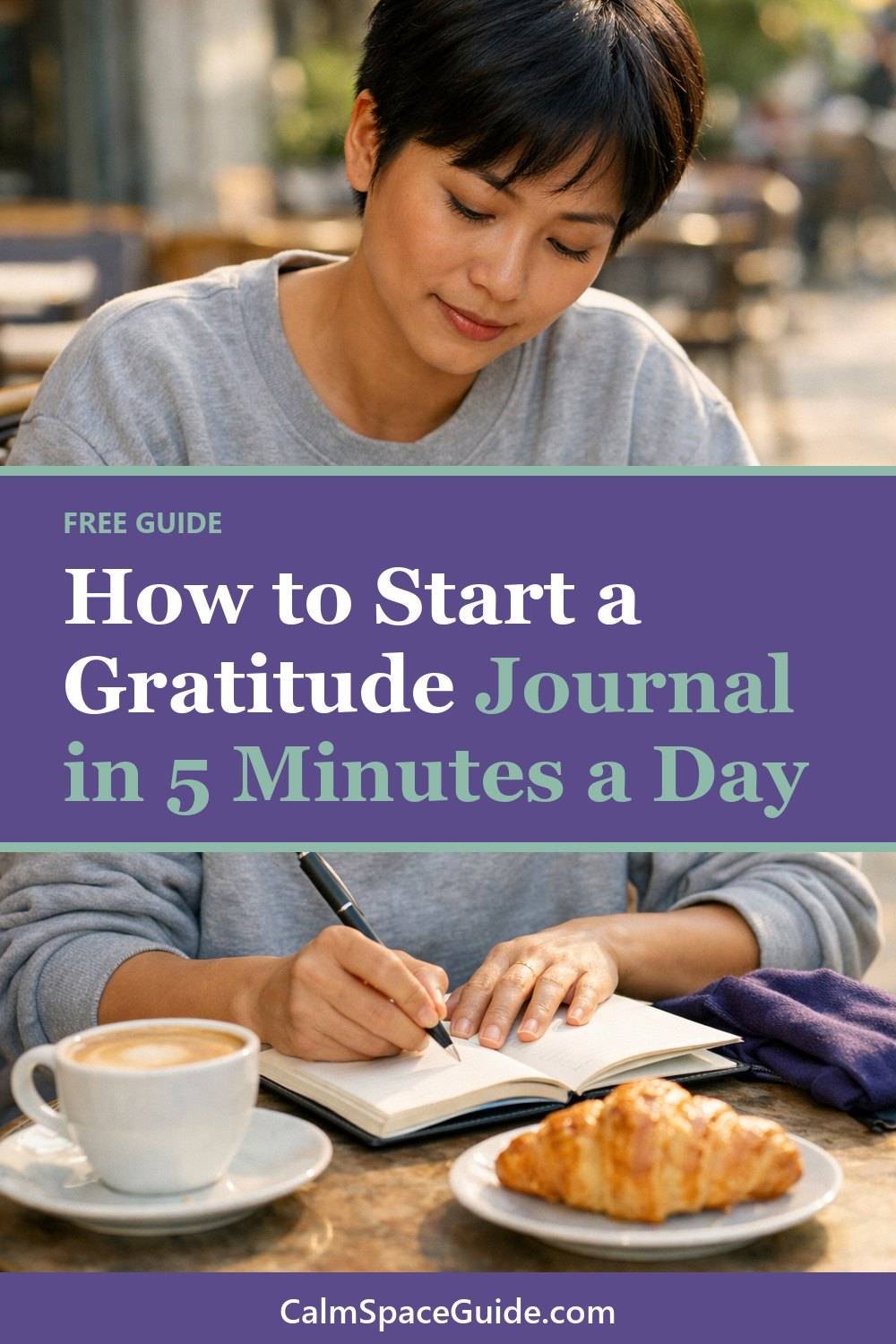
Step 5: Keep it where you'll see it
Put your notebook somewhere you'll walk past at the time you plan to write. For me, that's the bedside table. Try writing right before you turn off the light. For a friend of mine, it's next to the coffee maker, because she writes while the pot brews.
Out of sight really is out of mind. A notebook in a drawer is a notebook you'll forget about by Thursday.
Think about what you already do every day without fail. Brushing your teeth, making coffee, plugging in your phone at night. Tie the journal to one of those. "After I plug in my phone, I write three lines." It sounds almost too simple, but it works better than willpower.
Tip: If you share a space and feel a bit shy about it, a plain cover helps. Nobody's going to pick up a boring notebook to snoop. Mine looks like a grocery list pad, honestly.
Step 6: Review your guided gratitude journal pages on Sunday
Once a week, read back through the last seven days. It takes about two minutes.
This is my favorite part, and I didn't expect it to be. Reading a whole week at once is different from writing one day at a time. You'll see things you forgot already. Little kindnesses. Funny moments. A tough day that still had one good line.
You don't have to do anything with it. Just read. If something jumps out, you could circle it or put a small star next to it. Some people like to write one line at the bottom, like "Best thing this week:" and pick a favorite.
Tip: Pick Sunday, or any day that tends to be quieter for you. The day itself doesn't matter. Doing it the same day each week does.
Troubleshooting: when it isn't working
You keep forgetting
This is the most common one, and it's almost always a location problem. Move the notebook. Put it on your pillow in the morning so you have to move it at night. Or set a daily reminder on your phone for the same time each day. After a few weeks, you'll likely need the reminder less.
Your gratitude journal for adults feels repetitive
Go smaller. Instead of "the dog," try "the dog leaning against your leg while dinner cooked." You can also give yourself a mini theme now and then: something you heard, something you tasted, someone who helped you. It shakes things loose.
You had a really bad day
Some days are hard, and pretending otherwise doesn't help. On those days, I let myself write one line instead of three. Sometimes that line is "I got through today." That's enough. If you're going through something heavy for a long stretch, a journal is nice, but talking to someone you trust or a professional can help in ways a notebook can't.
It feels fake or forced
Honestly, it can feel a bit awkward the first week or two. It can feel like you're writing a greeting card. It got more natural once I stopped trying to sound grateful and just wrote plainly, like a note to myself. "Good sandwich today." Done.
You missed a few days
Just start again today. Don't go back and fill in the missed days, and don't beat yourself up about the gap. Gaps happen. Whole weeks may end up blank in a notebook. The habit is coming back, not having a perfect streak.
If you like tracking little routines and keeping an eye on calm-living deals in one place, the Calm Practice Deal Alert Setup Kit is below this post too. It's not needed for journaling at all, but some readers have asked about it.
Notebooks, pens and apps worth a look
You really can start with any pen and page, but a few well-known tools make the habit easier for some people. Here are options to consider if you want something a little more set up.
Leuchtturm1917 Notebook
A good fit if you like a tidy, numbered notebook you can keep for months. Check the page style (dotted, ruled or plain) before you choose, since that changes how it feels to write in.
Moleskine Classic Notebook
Suits people who want a familiar, sturdy notebook that feels a bit special. Check the paper weight if you use gel or fountain pens, as some inks can show through.
Five Minute Journal
A structured journal with set prompts, which suits beginners who stare at blank pages. Check whether you prefer the paper version or the app, and whether fixed prompts feel helpful or restrictive to you.
Pilot G2 Pens
A widely sold gel pen that suits anyone who wants a smooth, easy writing feel. Check the tip size, since a finer tip suits small handwriting and a bolder one suits larger writing.
Paper Mate InkJoy Pens
A easy-to-find pen for people who just want something that writes without fuss. Check the tip and ink style in the store, because feel is personal.
Day One Journal App
Suits readers who would rather type than handwrite, or who want to journal on more than one device. Check what the free version includes and how your entries are backed up before you commit.
Gratitude App
A phone app built around daily gratitude entries and reminders, which suits people who forget to write. Check the privacy settings and which features sit behind a paid plan.
Check current plans and prices on each brand's own site before you buy or sign up.
FAQ
Is it better to write in the morning or at night?
Whichever one you'll actually stick with. Night is nice because you have the whole day to look back on. Morning works too, you just write about yesterday or something you're looking forward to.
Can I use a notes app instead of paper?
Sure, if that's what you'll use, whether that's a simple notes app or a journaling app like Day One, though a gratitude journal for teens or grown-ups can work either way. Paper can be easier because a phone pulls you into messages and other apps. If you go digital, try turning on do-not-disturb for those five minutes.
What if I can't think of three things?
Write one or two. Three is a guide, not a rule. On slow days, basic stuff counts: a warm bed, clean water, a song you liked on the radio.
How long until it starts to feel like a habit?
It's different for everyone, so I won't give you a number. For me, it stopped feeling like effort after a few weeks of mostly showing up. Keep it short and easy, and give yourself some patience.
Your next step: a simple 7 day gratitude journal
Tonight, or tomorrow morning, grab a pen, write the date, and jot down three small good things. That's the whole start. If you'd like some help with the first week, sign up for the Free 7-Day Gratitude Journal Pages to download a simple page for each day. Then, if you want a notebook or tool to go with it, take a look at the products below this post. No rush. The pen and paper you already have are plenty to begin.
Printables and tools that can help
Calm Practice Deal Alert Setup Kit
Daily, weekly and monthly gratitude journal pages to print at...
See detailsCalm Space Journal and Log Book
A printable journal interior to record your routines, thoughts and plans for a calmer...
See details